
El Nino 2026 Category Risk Guide

Last update: 01/09/2026

Straight from our supply chain: the latest on how the 2026 El Niño event could affect the ingredients you buy from us, so you can plan and buy with confidence.

What Is El Niño?

El Niño is a recurring climate pattern that temporarily warms sea surface temperatures in the Pacific, and its effects ripple far beyond the ocean. Rainfall fails, droughts intensify, and growing conditions shift across the origins we source from. When it hits, it hits the ingredients on your specification list.

2026 Forecast

This is now tracking as one of the strongest El Niño events on record. As of 20 August 2026, forecasters put the chance of a very strong event above 90%, with a 69% chance that October to December 2026 alone exceeds every El Niño since 1950. The peak has also shifted later, to around January to March 2027, which pushes the period of concern for food supply into the second half of 2027. A second pattern, the positive Indian Ocean Dipole, is developing alongside this event and can strengthen, weaken or relocate the usual rainfall effects, particularly around the Indian Ocean and East Africa, so this year’s regional impacts may not follow the historical El Niño script exactly.


As harvests shrink and prices rise, the temptation to substitute origin, variety or grade increases, most often where a specification names a country, variety, species or certification (organic, Fairtrade, single-origin). We’re watching this closely across the categories in this guide, and we’ve flagged where the risk is clearest right now on the Coconut and Coriander pages.

Map showing El Niño's Easterly Trade Winds and Jet Streams across our key sourcing origins

El Niño shifts the Pacific’s easterly trade winds and jet streams, changing rainfall and growing conditions across the origins we source from.

~5% Average commodity price rise, lasting up to 16 months
Up to 9% Price climb in a strong El Niño event
9–12 months Typical lag before supply chains feel the impact

Rather than wait for issues to arise, we work with our supply chain and our customers to put contingency plans in place ahead of any disruption to supply and production.

Category Risk Overview

Tap any category below for the full breakdown: current conditions by origin, how this compares to 2023–24, and what it means for your buying decisions.

High: 5 categories Medium: 6 categories Low: 3 categories
Coconut Coconut Sri Lanka · Philippines · Indonesia MEDIUM

Harvests across all three origins are currently decent to very good, so this is a delayed-impact story rather than an immediate one. Farmers and processors are now forecasting a significant drop in Sri Lanka’s crop from Q2 2027, with major manufacturers expected to raise prices from late 2026 into early 2027 ahead of that.

62%Chance of El Niño conditions persisting (Sri Lanka)
Q2 2027Sri Lanka crop drop expected to begin
92%Probability of Philippines impact, Q4 2026

Key Points

Sri Lanka

  • There’s around a 62% chance of El Niño conditions (acute water stress and higher temperatures) emerging across June–August 2026 and persisting through at least the end of the year. Seasonal crops are highly exposed, with drought impact already being managed by the government; established coconut palms are more resilient.
  • The tall variety can handle a dry season of up to three months; the Dwarf × Tall hybrid struggles beyond two months. Prolonged dry weather without rain still slows growth and reduces yield.
  • Heat affects flowering rather than fruit already on the tree: flowers drop in the heat, meaning fewer fruits appear around a year later, so any impact from this year’s heat shows up as a smaller harvest in 2027, not immediately.
  • Storms remain a shorter-term risk to collection and shipping, separate from the drought picture.
  • Farmers and processors are now forecasting a major drop in the crop starting Q2 2027, in line with this delayed-impact pattern.
  • Major Sri Lankan manufacturers are expected to raise prices from late 2026 into early 2027, ahead of the anticipated drop.

2023–24, for reference

  • Production fell to around 2.75 billion nuts, the worst harvest in five years and roughly 8–10% down.
  • Export industry still grew 22% in value, on higher prices and record volumes (800,000+ tonnes).
  • Retail prices up ~63%, wholesale up ~36%, desiccated coconut export prices up ~30%.

Philippines

  • El Niño has not yet hit the Philippines coconut market, but the consensus is that it will. We’re finding a number of suppliers reluctant to commit to Q1 2027 shipments and supply.
  • A 92% probability has been put on moderate-to-strong El Niño impact on the Philippines in Q4 2026.
  • Risk is particularly concentrated in central and northern Luzon, historically the most drought-prone regions.

2023–24, for reference

  • Production dipped only slightly in 2023, but yield fell ~20% in 2024 as the drought caught up.
  • Coconut oil output down ~12% to a four-year low; exports projected down ~21%.
  • Government damage assessment: over ₱15 billion lost, 330,000+ tonnes affected.

Indonesia

  • There are early signs that El Niño is building, and some issues are already being felt. Exporters are growing increasingly nervous about what the months ahead will bring.
  • As Philippine and Indonesian coconut supply tightens, industry reporting flags a rising risk of coconut oil being diluted with palm kernel oil or other vegetable oils, and of virgin/refined or organic-status substitution.

2023–24, for reference

  • Farm yields fell an estimated 15–20%; some farms ran at only a third of normal capacity.
  • Local prices tripled in parts of the country; two processors laid off 3,500 workers combined.
  • Desiccated coconut export prices up ~77%, the sharpest rise of the three origins.

What This Means For You

Current-season supply across all three origins is solid, but the outlook shifts from Q4 2026 into 2027. Prioritise securing Sri Lankan and Philippine cover ahead of the anticipated price rises, and open supplier conversations now: reluctance to commit to Q1 2027 shipments is already showing. Keep a watching brief on Indonesia as early signals build, and request up-to-date certificates of analysis from affected suppliers given the rising substitution risk.

Dried Fruit Dried Fruit Turkey · Chile LOW

Turkish dried fruit (raisins, sultanas and apricots) is having a normal season, with no El Niño impact seen so far and a record year expected for both size and quality. Chile now has an initial update: still too early to assess any impact, though nothing of concern so far and conditions are being watched closely. China’s freeze-dried strawberry and raspberry lines are covered separately under Freeze Dried Fruit.

Normal seasonTurkey: no El Niño impact so far
90,000tTurkey’s estimated 2026 apricot crop
Low riskCategory-wide risk rating

Key Points

Turkey

  • The 2026 crop is tracking normally; no significant El Niño impact has been seen, and none is expected for the rest of the season.
  • This year’s apricot crop is estimated at around 90,000 tonnes, progressing well under good conditions.
  • Barring a natural disaster, expect a record year for both crop size and quality across all products.
  • Heat and drought stress ahead of harvest can raise the risk of aflatoxins in dried fruit, while poor drying conditions or humid storage add the risk of ochratoxin A: our partners’ usual mycotoxin testing stays in place through this year’s harvest and drying season.

2023–24, for reference

  • Aegean dried-fruit yields (grapes, apricots, figs) were down 25–30%; dried-apricot export volume fell around 22.5%, with export prices climbing from around $4,600/tonne to a peak of $6,274/tonne.
  • Raisins and sultanas saw a combined 30–35% impact on the crop, with prices up around 75% (this figure blends El Niño with other causes, not El Niño alone).
  • Most of that damage actually came from a coincidental heatwave and the February 2023 earthquakes, not El Niño itself: worth remembering when comparing years.
  • Separately, an April 2025 frost (unrelated to El Niño) cut that year’s apricot crop by around 74%, the dominant factor in 2025/26 supply and pricing rather than El Niño.

Chile

  • Latest international climate forecasts point to El Niño strengthening through the second half of 2026, possibly continuing into 2027, with current outlooks indicating a strong event.
  • It’s still too early to accurately assess the impact on Chilean agriculture: the actual effect on yield, quality and availability will depend on how the season develops.
  • No specific concerns currently affecting supply programmes; weather developments are being monitored closely, with regular contact kept with producers and industry partners.

What This Means For You

Turkey needs no action right now: this is a good window to place forward orders at stable pricing. Nothing concrete to act on for Chile yet either, but we’ll keep monitoring as the season develops.

Black Pepper Black Pepper Vietnam · Sri Lanka · Indonesia · Brazil MEDIUM

This is the clearest case this season of El Niño hitting one supplier while leaving the others unaffected. Vietnam’s crop is genuinely smaller this year; Sri Lanka, Indonesia and Brazil are all having stronger seasons. The net effect right now is prices easing globally, even though Vietnam itself remains tight.

-8 to -10%Vietnam production vs last year
+10 to 15%Sri Lanka, Indonesia & Brazil production
SofteningPrices easing across most origins

Key Points

Vietnam

  • Harvest is finished. Production is confirmed down 8–10% on last year due to poor growing-season weather.
  • New flowers are forming for next season, and conditions have been good so far. This is an important stage to watch given ongoing uncertainty.
  • Prices are down slightly month-to-month and around 8% below last year.

2023–24, for reference

  • Production cut 10–20%, prices up ~50% in H1 2024, far sharper than today’s softening.
  • Other three origins weren’t picking up the slack back then the way they are now.

Sri Lanka

  • Harvest is under way, with the main “bold” pepper crop still to peak in August.
  • Production is expected 10–15% higher than last year.
  • Prices are down slightly, around 10% below last year.

Indonesia

  • The new harvest is improving, with a better crop expected overall (10–15% up).
  • Prices are down around 4% on last year.

Brazil

  • Harvest is ongoing into September, with a bigger crop expected (10–15% up) and healthy stock levels.
  • Brazil is currently the cheapest origin globally, and for the first time this year is trading below last year’s price level.

What This Means For You

If your pepper is Vietnam-origin, keep an eye on the flowering period over the coming weeks. Elsewhere, the current softening makes this a reasonable window for cover.

Chilli, Capsicum & Paprika Chilli, Capsicum & Paprika India HIGH

All three of these lines are tight right now: carryover stock from last season is well down across the board, and prices have already moved a long way. Good rain in late July has supported this year’s sowing, but it will be several weeks before we know how the new crop is shaping up. Material meeting EU pesticide standards is especially scarce.

-60%Chilli carryover stock vs normal
+65 to 90%Prices up across all three lines
End of AugustClearer picture on new chilli crop

Key Points

Chilli

  • Good rain in the second half of July eased concerns and encouraged more planting.
  • Carryover stock from last season is around 60% lower than normal.
  • Certified pesticide-compliant material is limited.
  • Heat and drought stress ahead of harvest raise aflatoxin risk, with poor drying or humid storage adding ochratoxin A risk on top: our partners’ usual mycotoxin testing stays in place on affected lots through this period.

2023–24, for reference

  • A patchy monsoon and low reservoir levels followed a similar pattern.
  • Yields fell and prices rose gradually over months, not in one sudden shock.

Capsicum

  • Harvest for the current crop is finished; sales are running on carryover stock, down 35–40% on last year.
  • Prices are running around 65% above last year, though they have levelled off month-on-month.
  • Sowing for the new season is going well, with the growing area up 30–35% in central India.
  • Certified pesticide-compliant material remains limited, in line with the category as a whole.

Paprika

  • Harvest is over, and carryover stock is down around 50% on last year.
  • Prices are up around 90% on last year, one of the sharpest moves in this report.
  • New season sowing is around 70% complete.
  • Certified pesticide-compliant material remains limited, in line with the category as a whole.

What This Means For You

Cover near-term requirements across all three now rather than waiting for the new crop: stock is tight and prices have already moved.

Coriander Coriander India · Eastern Europe HIGH

India’s coriander crop is the tightest story in this report: production is down sharply, stock is low, and prices have roughly doubled on last year. Eastern Europe is also short on carryover stock, but prices there have stayed flat, suggesting buyers are waiting for the upcoming harvest rather than bidding up scarce material.

-20%+India production vs last year
~2xIndia prices roughly doubled
Jan–Mar 2027Expected India supply gap

Key Points

India

  • Production is down more than 20% on last year, with carryover stock down 20–30%.
  • Prices have climbed for three months running and are now roughly double last year’s level.
  • Stock is expected to run out around January 2027, and the next crop isn’t ready until March/April 2027, a real gap in between: worth treating this window as a period to double-check origin documentation rather than relax it.

Eastern Europe

  • Sowing is complete and the growing area is up slightly; the next harvest is due soon.
  • No carryover stock from last year is keeping the market firm.
  • Ongoing international conflicts are adding to shipping delays and costs.
  • Prices are up around 40% on last year, but have stayed flat month-to-month.

What This Means For You

Cover near-term coriander requirements now rather than waiting for the next crop: stock is down and prices have already moved a long way.

Cumin Cumin India LOW

The one settled category in this report. Carryover stock is above average, and prices have only just crept above last year’s level after months of trading below it. The one to watch isn’t this year’s crop but next year’s: fewer farmers are planning to grow cumin after a run of weak prices.

Healthy stockBest-supplied spice in this report
+5%Prices just above last year
-25 to -30%Planted area expected next season

Key Points

India

  • Stock levels are healthy, the best-supplied major spice in this report.
  • Prices have turned around over the last three months and are now around 5% above last year.
  • Planted area for next season is expected to fall 25–30% on weaker recent prices.

What This Means For You

No urgency here: a good window to plan ahead without rushing.

Freeze Dried Fruit Freeze Dried Fruit China (Strawberry · Raspberry) HIGH

Freeze-dried strawberry is the higher-risk line here: China’s main growing regions saw real production losses in the last El Niño event, and prices spiked sharply around Spring Festival. Freeze-dried raspberry is more resilient, with only indirect, inferred impacts and a more limited price effect. 2026 forecasts point to a repeat pattern: strawberry hit hardest, raspberry affected but manageable.

-15 to -30%Strawberry yield loss forecast
+30 to 50%Strawberry price surge forecast
-10 to -20%Raspberry yield loss (lower risk)

Key Points

China: Strawberry

  • Main producing regions (Shaanxi, Shandong, Liaoning) face the same warm-winter, wet-summer pattern that caused problems last cycle: insufficient winter chilling delays flowering, and summer heavy rain and high heat drive disease outbreaks (root rot, anthracnose, grey mould).
  • 2026 forecasts point to a 15–30% yield loss in main producing areas, with a 5–10% national decline.
  • The price impact is expected to be sharper and faster than the yield loss: a 30–50% surge is forecast around the pre-Spring Festival period, with volatility continuing longer term.
  • Mitigation under way: adjusting seedling regions to lower-risk areas, strengthening soil management, and more precise, targeted pest control.

2023–24, for reference

  • Production down 10–30%; fruit-set rates cut 15–20%, missing the Spring Festival window.
  • Open-field losses of 20–30% from summer heat and rain.
  • Prices rose sharply during the core period, around 39% at peak.

China: Raspberry

  • China-wide raspberry-specific data is more limited, so this assessment is based on related crops with a similar chilling and disease profile (such as blueberry), and is rated lower risk than strawberry.
  • 2026 forecasts suggest a 10–20% yield loss in main producing areas, with southern regions expected to stay stable.
  • Price increases of 10–20% are forecast, though much of this is expected to come from logistics and labour costs rather than El Niño directly.
  • Mitigation under way: breeding more heat-tolerant varieties, greater use of greenhouse protection, and improved water and fertiliser regulation.

2023–24, for reference

  • Fruit-set rates cut 10–15%; fresh fruit output down an estimated 5–10%.
  • Fruit cracking up 20–30% from summer rain and heat.
  • No large-scale crop failures recorded; price impact was limited.

What This Means For You

Prioritise cover on freeze-dried strawberry given the confirmed pattern of yield loss and sharp pre-Spring Festival price spikes. Freeze-dried raspberry cover can likely wait for firmer signals: the risk is real but smaller and slower-moving.

Ginger Ginger India · China · Nigeria HIGH

India’s ginger crop is under real pressure: dry, compliant material is very scarce, and prices are up sharply. China’s ginger, by contrast, has never shown any sensitivity to El Niño and isn’t a concern this year. Brusco’s own stock for this season is due in September, which will help bridge the gap.

+70%India prices vs last year
SeptemberBrusco’s own-stock ginger arrives
No El Niño linkChina’s ginger crop unaffected

Key Points

India

  • Fresh ginger is moving well, but dry, pesticide-compliant material is very scarce: low yields and wet weather have delayed drying.
  • Prices are up around 70% on last year.
  • Separately, heavy rain has reportedly damaged next season’s crop as it was being planted; the impact on yield won’t be clear until later this month.

China

  • Harvested once a year, in September. Has never shown any sensitivity to El Niño, and none is expected this year.

Nigeria

  • A better crop is expected this year, with a larger growing area.
  • Prices have stayed flat, and the dry-weather risk we were previously watching hasn’t materialised so far.

What This Means For You

Brusco’s own ginger stock arrives in September at competitive prices, covering Q4 2026 into Q1 2027. Further guidance on India’s rain-damaged planting will follow once the picture is clearer, expected next month.

Rosemary Rosemary Morocco LOW

Morocco’s rosemary harvest is under way and going well, with only modest price pressure carried over from thin stock last season.

On trackMorocco harvest close to last year’s yield
+12%Prices above last year, gap narrowing
Low riskCategory-wide risk rating

Key Points

Morocco

  • Harvest has started and is going well, with yield almost matching last year.
  • No carryover stock from last season is keeping prices firm, around 12% above last year, though that gap has narrowed recently.

What This Means For You

No action needed here for now.

Turmeric Turmeric India MEDIUM

This year’s harvest and sowing are both complete, and carryover stock is tight. Rainfall has shifted in the wrong direction for two key growing states, adding real uncertainty to next year’s crop. Prices are already up on last year, and a clearer picture isn’t expected until mid-September.

+15%India prices vs last year
Mid-SeptemberClearer picture expected
Certified alternativeRainforest Alliance turmeric available

Key Points

India

  • Karnataka and Tamil Nadu are now short of rain (a change from the picture a month ago), and some farms are already seeing lower groundwater levels.
  • Maharashtra, by contrast, has had good rain this month.
  • Prices are up around 15% on last year.
  • Reduced rainfall raises aflatoxin risk in the field, and as prices firm, the incentive for origin or grade substitution: our partners’ usual testing and sourcing checks stay in place given carryover stock is already tight.
  • Rainforest Alliance certified turmeric is available as an alternative, for extra sourcing assurance.

What This Means For You

Cover turmeric requirements through to the first quarter of next year (Q1 2027) to manage this uncertainty.

Tomatoes Tomatoes Spain/Portugal · China · South America HIGH

China’s tomato crop has already taken confirmed damage this season, with yields down. Spain and Portugal remain stable for now, with plenty of water in reserve and no clear link to El Niño yet. South America’s harvest is already complete, so there’s no exposure left this year.

-15 to -20%China yield confirmed down
6 harvestsSpain’s water reserve cover
CompleteSouth America harvest: no further risk

Key Points

China

  • Very heavy rain hit Inner Mongolia earlier in the season, followed by an unusually hot April and then an unusually cool May, poor timing for young plants.
  • Heat has since damaged flowers and fruit, and tomatoes are coming through smaller than normal.
  • Yield is now confirmed down 15–20% this season.

Spain & Portugal

  • Crop remains stable. Heat stress during flowering and storms late in harvest are the main factors being watched, not El Niño directly.
  • The key Spanish supplier has enough water in reserve to cover the next six harvests, with no change reported since mid-July.

South America

  • Harvest is already complete for this cycle, so there’s no further weather risk this season.

What This Means For You

Prioritise securing China-origin cover given the confirmed yield hit. Spain and Portugal can likely wait for firmer signals before acting.

IQF Vegetables IQF Vegetables China MEDIUM

China’s frozen vegetable crop overall is rated medium risk, but that masks significant regional variation. Onions and peppers grown in Inner Mongolia and Gansu are the areas to watch most closely.

-15 to -25%Inner Mongolia & Gansu onion yield
+25 to 40%Inner Mongolia pepper prices
OctoberTighter storage-onion supply from

Key Points

China: General

  • Heavy rain caused serious flooding through mid-July, with some crops wiped out completely.
  • From August, the forecast turns to persistent heat and drought, especially affecting autumn planting.

China: Onions

  • Yunnan’s harvest was already finished before this year’s El Niño took hold, so it’s unaffected.
  • Central growing regions (Jiangsu, Henan, Shandong) are close to normal.
  • Northeast China is expected to be down 10–20% on yield.
  • Inner Mongolia and Gansu, the hardest hit, are expected to be down 15–25% (up to 30% in the worst areas).
  • Expect tighter supply of storage-quality onions from October onwards.

China: Peppers

  • Shanxi green peppers: yield expected down 10–15%, prices expected up 15–30%.
  • Inner Mongolia red/yellow peppers: yield expected down 15–25%, prices expected up 25–40% (more for the best grades).

What This Means For You

Treat Inner Mongolia and Gansu-origin onions and peppers as the priority for any cover discussions within this category.

Onions & Garlic Onions & Garlic Spain · China MEDIUM

Spanish ambient onions aren’t expected to be affected: El Niño is primarily a Pacific Ocean event, not one that reaches this region directly. China’s onion and garlic season has been delayed by heavy rain, and next year’s crop could be at risk if hot, dry weather continues.

No impact expectedSpain ambient onions
+1 monthChina’s season pushed back
Watch 2027China’s crop at risk if dry weather continues

Key Points

Spain (Ambient Onions)

  • The supplier doesn’t expect any impact, given El Niño’s Pacific origin.

China

  • Heavy rain has pushed the season back by at least a month.
  • If high temperatures continue alongside low rainfall, the 2027 crop could be affected.

What This Means For You

No urgent action needed on Spain; keep an eye on China’s timing as the season develops.

Dehydrated Onion Dehydrated Onion India (Gujarat) MEDIUM

Dehydrated white onion relies heavily on India’s winter crop, and that crop is currently under some strain. The monsoon-season crop is unaffected. Rain so far has been decent but not quite enough for a bumper harvest, and a few key growing areas are seeing real shortfalls.

On trackKharif (monsoon-season) crop unaffected
Under stressRabi (winter) crop, the backbone of supply
Mid-OctoberClearer picture on planting decisions

Key Points

India (Gujarat)

  • The Kharif (monsoon-season) crop has stayed out of danger all the way through this year’s El Niño.
  • The Rabi (winter) crop is the one to watch: it’s the backbone of dehydrated white onion supply, and it’s currently under stress.
  • Rainfall so far has been decent, but not enough to produce a bumper crop.
  • Nearby growing areas, Kutch, Jamnagar and Gir Somnath, are facing serious rain shortfalls and drought-like conditions.
  • There’s still hope for more rain through to mid-October. If it doesn’t arrive, some farmers may switch away from onions toward faster-growing table and kitchen crops instead, which would shrink the area planted with onions.

What This Means For You

Worth watching closely through to mid-October, when the rain outlook and planting decisions should become clearer. If the rain falls short, growers switching away from onions could tighten dehydrated white onion supply next season.


Talk to the Team

Due to El Nino being so volatile, this information will be regularly updated to match what is happening in the market. If you’d like to talk through what any of this means for your business, get in touch and we’ll help you plan ahead.

Get In Touch or call +44 (0) 1386 761555 · info@brusco.co.uk

Turmeric Market Report August 26

Turmeric Prices Climb as Tight Stocks Meet an Uncertain New Crop.

Turmeric prices have moved up sharply in recent weeks, and the market points to further rises ahead, meaning buyers who secure cover now stand to pay less than those who wait.

Why are Turmeric Prices Rising?

We’re seeing turmeric prices rise by approximately USD 200–300/MT in recent weeks, driven by a smaller crop last season and growing market expectations of tighter future supply as El Niño conditions weigh on the 2026–27 crop. If you haven’t secured your requirements yet, this is the moment to have that conversation with us.

  • New crop pressures from El Nino
  • Sowing is delayed
  • Carry over stocks are tight

What does this mean for our customers?

With material availability expected to tighten from August onwards until the next harvest, grower-side sentiment points to prices continuing to climb in the months ahead.

Continued strength in NCDEX futures is underpinning spot prices, and availability of IPM/low-residue compliant material remains limited, keeping premiums firm for buyers who need certified supply. IPM compliance is the standard our own turmeric supply is held to, so this is the segment worth watching most closely: as good-quality compliant stock tightens further, buyers who  haven’t secured volumes risk paying a growing premium or facing limited availability altogether.

Next steps

Given the combination of a tightening carry-over position, a weather-exposed new crop, and fast-moving spot prices, we’re recommending customers cover their turmeric requirements through to Q1 FY27 to manage exposure to further price rises. We’re also able to source Rainforest Alliance certified turmeric at a competitive price. The certification gives you independently audited assurance that the crop meets recognised sourcing and compliance standards, useful reassurance at a time when good-quality, fully compliant material is harder to come by.

If you’d like to discuss locking in cover through Q1 FY27, get in touch with the team.

For more information on the turmeric market, download our full report and get in touch with the team today to discuss covering your volumes.

Understanding El Niño: The Climate Event Shaping Global Ingredient Markets

The NOAA has officially announced the arrival of the 2026 El Niño, stating that we are to expect a prolonged period of above-average temperatures in the equatorial Pacific, with conditions expected to peak this winter.

Although El Niño is a weather pattern that occurs every few years, this year’s event is forecast to reach at least moderate, and possibly strong, intensity. But what exactly is El Niño, and how could it affect the food industry over the next 12 months?

What Is El Niño and Why Is It Important?

El Niño is one of the most influential climate patterns affecting global agriculture. Although it originates in the Pacific Ocean, its effects can be felt across the world’s major growing regions, altering rainfall, temperatures, and crop yields.

For food manufacturers, procurement teams, and NPD professionals, El Niño is more than a weather event. It can influence ingredient availability, pricing, and supply chain stability months before its effects are seen in the market.

What Causes El Niño?

El Niño is a naturally occurring climate pattern caused by the periodic warming of sea surface temperatures across the central and eastern tropical Pacific Ocean.
It forms part of a larger cycle known as ENSO (the El Niño–Southern Oscillation), which also includes La Niña (the cooling phase) and the neutral periods in between.

The Role of Trade Winds and Pacific Ocean Temperatures

Under normal conditions, strong east-to-west trade winds push warm water westward across the Pacific, allowing cooler water to rise to the surface off the coast of South America.

During El Niño, these trade winds weaken. Warm water spreads eastward instead, and the redistribution of heat in the ocean triggers a series of atmospheric changes that ripple across the globe.
This alters rainfall patterns, temperatures, and seasonal timing in regions far removed from the Pacific itself.

El Niño Intensity Levels Explained

El Niño events are classified by levels of intensity: weak, moderate, strong, or very strong.

How Often Do El Niño Events Occur?

They typically last between nine and twelve months, although some events can continue for longer. El Niño events recur every two to seven years, but no two events are identical in either strength or geographic impact.

How Does El Niño Affect Global Agriculture?

What Are Climate Teleconnections?

What makes El Niño particularly significant from an agricultural perspective is the global reach of its downstream effects.

El Niño doesn’t just affect the Pacific region. Through a process known as teleconnections, changes in Pacific Ocean temperatures can influence weather patterns around the world.

Which Regions Are Most Vulnerable to El Niño?

El Niño can contribute to drought conditions in South and Southeast Asia, flooding across parts of South America, reduced monsoon rainfall in southern Africa, and unusually warm conditions in parts of Europe and the Middle East.

The effects are real, documented and, in many cases, predictable. This is exactly why monitoring El Niño is central to how we manage supply risk at Brusco.

Why Does El Niño Matter to Food Manufacturers and Ingredient Buyers?

Agriculture is, at its core, a climate-dependent industry. Crops are grown according to seasonal rhythms, planting windows, rainfall requirements, temperature ranges and harvest timings that have developed over centuries of farming practice.

El Niño disrupts those rhythms and, when it does, the effects translate directly into yield losses, quality issues, price volatility and supply shortages.

How El Niño Impacts Crop Production

The impacts vary by region and crop, but some of the most consistent effects include:

Drought Stress in Key Growing Regions

In South and Southeast Asia, El Niño typically reduces monsoon rainfall. When water stress occurs during critical growth stages, both yield and crop quality can suffer.

Flooding and Excess Rainfall

In parts of South America, El Niño brings excess rainfall, which can lead to waterlogging, fungal disease and harvest disruption. Too much water at the wrong time can be just as damaging as too little.

Shortened Growing Seasons and Quality Losses

Unusually high temperatures or erratic frosts can compress growing windows, reducing the volume of produce that reaches harvest. Quality grading may also suffer, leaving a larger proportion of crops outside commercial specifications.

Long-Term Effects on Future Harvests

Perhaps the most underappreciated impact is the lag effect. If a growing season is damaged, the following year’s contracted volumes, forward pricing and planting decisions are also affected.
Recovery in agricultural supply chains is rarely immediate.

How Could El Niño Affect Ingredient Prices in 2026?

When crop yields decline or harvests are disrupted, ingredient markets often experience supply constraints and increased price volatility.

For manufacturers, this can create challenges around budgeting, procurement planning and product development. Categories heavily exposed to weather-related risks may see tighter availability and longer lead times, particularly if multiple producing regions are affected simultaneously.

As the 2026 El Niño develops, businesses should closely monitor ingredient markets where supply is concentrated in climate-sensitive growing regions.

Which of Your Categories Are Most Exposed?

El Niño’s impact isn’t uniform across our range, and the picture that emerges from our own category data is more mixed than a single “monsoon risk” story would suggest.

Highest exposure.

Tomatoes carry the broadest high-risk footprint in our range, flagged across Europe/China, Spain/Portugal, China, and South America — making it the category with the most geographic spread at the top of the scale. Vietnamese black pepper and Indian spices are also rated High Risk, consistent with monsoon-driven origins.

Medium exposure.

Chinese-origin IQF vegetables — including the onion and pepper lines specifically — sit at Medium risk, as do Southeast Asian coconuts. These aren’t flagged as immediate concerns, but they’re on the list to watch.

Lower or uncertain exposure.

Turkish and Egyptian herbs, Spanish ambient onions, and Chinese sweet ginger are all rated Low. China/garlic onions sit in a “possible risk” category, not dismissed, but not firm either. European IQF veg is currently TBC, meaning we don’t yet have a confident call to make.

The honest takeaway: the risk isn’t confined to Asia or to monsoon-fed crops, tomatoes are our single widest-spread high-risk line, spanning four separate origins. Treating any one region as the whole story would understate where the real exposure sits.

How Can Food Manufacturers Prepare for El Niño?

If you’re planning product development, securing volumes for the year ahead or reviewing your raw material strategy, El Niño should already be part of the conversation.
The opportunity to manage risk comes before supply gaps appear in the market—not after.

A few sensible steps to make sure you’re covered:

  • Lock in forward cover on your most exposed lines earlier than usual, rather than buying spot into a rising market.
  • Diversify origin where the spec allows, so you’re not reliant on a single climate-sensitive region.
  • Hold a modest buffer stock on critical ingredients to absorb lead-time disruption.
  • Review your 12-month volume plan now and stress-test it against a tighter-supply scenario.
  • Talk to your supplier early about which categories they see hardening, so you’re planning with real intelligence rather than reacting.

At Brusco, we work to give our customers visibility before it becomes urgency.

That means sharing what we’re hearing from the market, advising on where to build cover and being honest when we see risk building in a category.

Currently, we are still so early into the cycle caused by El Niño, but we are already receiving feedback from our partners as to how they see their harvest and production playing out over the next 12 months. As that picture firms up, we’ll flag material risk directly to the customers we’re actively working with, through your account manager and our category updates. If you’d like to be kept in the loop on a particular category, let us know and we’ll add you to that update.

If you’d like to discuss your specific ingredient exposure or receive a more detailed briefing on any of the categories covered in this article, get in touch with your Brusco account manager or contact our team directly.
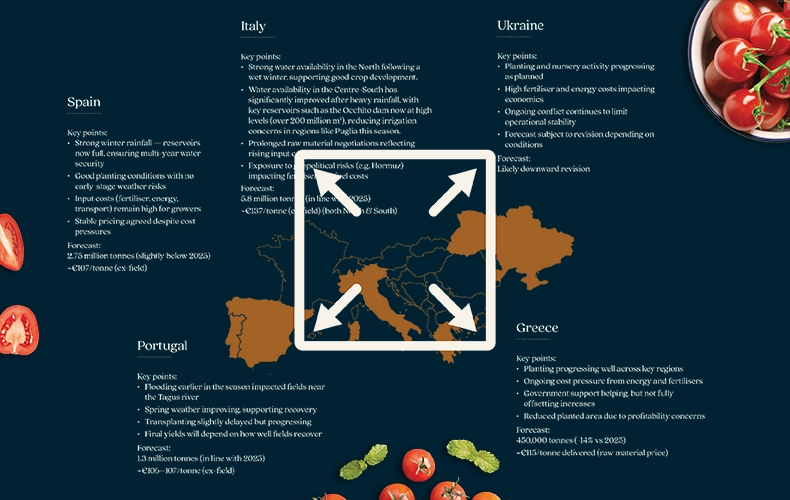
Tomato Market Updates 2026

Supply Stabilises – Now’s the Time to Buy Smarter, Not Faster.

The 2026 tomato season is looking more stable, but it’s not necessarily any easier to navigate.

After a couple of years swinging from oversupply to correction, things have settled down. There’s enough product in the market, just not the excess we’ve seen before. That gives buyers more options but also  means being more considered about where you buy from, what you pay, and who you work with.

Sources: WPTC, Tomato News, and our trusted supply chain

Take Your Time, But Plan Properly

Unlike previous years, there is less pressure to rush decisions.

  • More time to benchmark suppliers and origins
  • Greater ability to compare pricing and value
  • But reliable supply still needs forward planning

Pricing: More Opportunities Emerging

The pricing environment is starting to ease in certain areas, but not everywhere.

  • Prices expected to be flat to slightly softer overall
  • Continued pressure on higher-cost regions like Europe
  • More competitive offers from alternative origins

Europe: Reliable, But Expensive

Europe remains a key sourcing region, but cost pressures continue to build. This continues the trend seen in 2025, where weather and reduced planting tightened regional supply.

  • Reduced planting in recent seasons
  • High energy and fertiliser costs
  • Ongoing weather-related risks

This continues the trend seen in 2025, where weather and reduced planting tightened regional supply

A More Balanced Global Market

  • The market is balanced, with supply and demand more aligned.
  • Global production holding around 39–40 million tonnes
  • Well below the oversupply years of 2023 and 2024
  • Buyers continuing to diversify sourcing across regions

Supply Is There, Just Not All in One Place

  • Global volumes are stable, but supply is more spread out.
  • Growth in Egypt and Turkey
  • Lower output in parts of Europe
  • China increasing, but not enough to shift pricing significantly

World Wide Overview

worldwide map showing tomato origins

Download full report 

Last updated 15/05/2026

Next Steps

This is not a shortage market, it’s a decision-driven market. You have more options than
last year, but also more variables to manage.

Avoid locking in too early, instead talk to the team today about your volumes so we can
find the right solution for you and your production by:

• Benchmarking across origins
• Use competitive regions to manage cost
• Keep flexibility as the season develops

Dehydrated Onion Market Report April 2026

Dehydrated Onion Supply Under Pressure in a Volatile Market

The dehydrated onion market is becoming more volatile. While supply remains tight compared to last year, recent geopolitical disruptions have temporarily changed supply flows, creating short-term uncertainty

What is happening in the Dehydrated Onion Market?

  • Export Disruptions Increasing Supply in the Local Market
  • Higher Supply Creating Short-Term Price Movement
  • Rising Costs Adding Pressure to the Market
  • Carry-Forward Stock Limited
  • Shorter Dehydration Window
  • Harvest Delayed by Weather Disruption
  • Reduced Planting Forecast

Download Full Report Here

Next steps for Customers Looking to Purchase Dehydrated Onion

The market outlook remains firm, with lower crop availability and limited dehydration capacity expected to continue restricting supplies of good-quality material. As the season progresses and availability tightens, prices are expected to continue strengthening.

Given these factors, along with ongoing geopolitical uncertainty, we recommend speaking with our team to review your requirements and secure volumes early—helping to protect supply and potentially lock in more favourable pricing before further market movement.

Meet our Dehydrated Onion Expert Neil Burton

Neil has extensive knowledge of the dehydrates market across multiple origins. He is always happy to share his insight and provide updates on the latest market developments.

Please get in touch with Neil if you would like to talk about the dehydrates range.

Cumin Market Report April 2026

Reduced Planting Expected to Push Prices Higher Later in the Season as Harvest Starts in India

Cumin prices are currently holding steady, but the market is expected to tighten as the year progresses. Prices likely to increase as supply levels and export demand evolve.

What is happening in the Cumin Market?

  • Planting is slightly lower this season
  • Harvest has begun in some areas, with peak supply expected through until May
  • Yields look similar to last year
  • Good carry-over stocks available
  • Slow market arrivals as farmers hold stock
  • IPM quality commanding higher prices
  • Prices stable vs last year

“Lock in competitive pricing and guarantee your stock for the year”

Download Full Report Here

Next steps for Customers Looking to Purchase Cumin

The main harvest window from March to May is typically when the most cumin enters the market and when prices are often most competitive.

April is expected to see a temporary price drop, so we are advising customers to get their volume requirements ready to share with our team, so we can contract for the year. Offering the best price and guaranteeing your stock.

Meet our Cumin Expert Neil Burton

Neil has extensive knowledge of the cumin market across multiple origins. He is always happy to share his insight and provide updates on the latest
market developments.

Please get in touch with Neil if you would like to talk about cumin or the wider spices range.

Indian Chilli Market Report April 2026

Smaller Indian Chilli Crop and Quality Issues Predicted to Push Prices Higher

Higher prices and tighter supply are projected for Indian chilli over the coming months. With a smaller crop expected this season and limited availability of higher-quality material, customers may benefit from planning purchases earlier than usual.

What is happening in the Indian Market?

  • The harvest has started, but supply will be lower this year
  • Prices are already higher than last year
  • Carry-over stocks are slightly higher but not enough to offset the short crop
  • Demand remains strong both in India and overseas
  • High-quality chilli may be harder to find

Chinese Chilli Offers Alternative to Indian Crop as Availability Tightens

China remains a competitive sourcing option; however, prices have risen sharply by approximately 8–10% since the Chinese New Year period. The country is now approaching the end of its production season, and availability of high-quality raw materials is becoming increasingly limited.

With temperatures set to rise from early April, any remaining stock will require cold storage, adding further cost pressure. The combination of reduced quality material in the market and increased storage expenses is expected to continue driving prices upward in the near term.

Download Full Report Here

Next steps for Customers Looking to Purchase Indian chilli

Given the expected reduction in chilli supply this season, we recommend reviewing purchasing plans for both Chinese and Indian chilli. April is forecast to see the best prices for Indian Chilli so securing volumes earlier may help reduce exposure to further price increases as the market develops.

Buyers who require specific grades, particularly IPM-compliant chilli or consistent colour and heat levels, may also benefit from confirming quality requirements early, as availability of these grades could become tighter as the season progresses.

We also expect Indian chilli prices to remain relatively firm throughout 2026 due to the smaller crop.

Meet our Chilli Expert Neil Burton

Neil has extensive knowledge of the chilli market across multiple origins. He is always happy to share his insight and provide updates on the latest
market developments.

Please get in touch with Neil if you would like to talk about chillis or the wider herbs and spices range.

Paprika Market Monthly Updates 2026

 March | April | May | June | July | August | September | October | November | December

As the season progresses, the global paprika market moves into a more active phase, one that can have a direct impact on supply, pricing and contracting decisions.

For customers relying on consistent quality and dependable sourcing, understanding what’s shaping this year’s crop is key.

Our team, including Herbs and Spices specialist Neil, is tracking developments across the main producing regions, from weather patterns to planting and harvest progress. These insights are designed to give you a clearer view of the market, helping you plan procurement, manage contracting windows and set realistic pricing expectations.

For the latest paprika market update, get in touch with Neil Burton at neil.burton@brusco.co.uk or call 01386 761 555.

March

Indian Paprika Price Update

  • Prices for hybrid varieties have declined by 15–20% month-on-month
  • Despite this drop, prices remain significantly elevated
  • Current levels are still around 70–80% higher than the same period last year

Indian Paprika Crop Update

  • Paprika harvest is currently underway, with around 60–70% of the crop completed
  • Pesticide usage has been higher this season compared to last year
  • Carry-forward stocks sit at moderate levels relative to a typical year
  • Overall production is expected to decline
  • This is driven by a 35% reduction in cultivated area, alongside an estimated 10% drop in yields
  • Market demand remains active, with masala companies and stockists continuing to buy

Black Pepper Monthly Market Updates 2026

2025 | | January | March | April | May | June | July | August | September | October | November | December

As the 2026 black pepper growing season progresses, the global market is entering a pivotal period that will shape availability, pricing dynamics, and contract timing over the year ahead. For manufacturers and foodservice operators relying on consistent quality, continuity of supply, and cost control, early visibility of crop developments is increasingly critical.

Our specialist team, including Herbs and Spices expert Neil, will continue to share regular 2026-focused updates from key black pepper origins. These updates will track weather conditions, crop performance, harvest progression, and stock positions, helping customers anticipate market movements rather than react to them.

By combining origin insight with market intelligence, we support customers in making more confident procurement, contracting, and pricing decisions throughout 2026.

For the latest 2026 black pepper market update, contact Neil Burton at neil.burton@brusco.co.uk or call 01386 761 555.

March 2026

Vietnamese Black Pepper Price Update

  • Prices are 1–2% lower compared to last month and approximately 5% lower than last year
  • They are still high compared to normal historical levels.

Vietnamese Black Pepper Crop & Market Update

  • Harvest is now underway in Vietnam, with peak arrivals expected late March through April
  • Around 10–15% of the crop has been harvested to date
  • Total output is projected to be approximately 8% lower year-on-year
  • Carry-over stocks are at very low levels
  • Farmers are holding back material in anticipation of stronger pricing
  • Residual stocks from previous seasons have largely been cleared
  • Demand remained strong in February, particularly from the USA, Middle East and Southeast Asia
  • Harvest activity is currently concentrated across key Central Highlands regions, including Dak Lak and Dak Nong
  • With domestic availability tight, Vietnam is supplementing supply with imported pepper to support export commitments

Sri Lankan Price update

  • Prices are down 1–2% month-on-month
  • Current levels are broadly in line with last year

Sri Lankan Black Pepper Crop & Market Update:

  • The next light berry pepper harvest is expected to begin May–June
  • Peak arrivals are likely from June through to August
  • Growing conditions remain favourable overall
  • 2026 crop output is expected to be strong, despite some vine damage from the recent cyclone
  • Berry development is progressing well, supported by low rainfall and stable weather conditions
  • Demand from India remains firm
  • This is driven by continued reliance on Sri Lankan pepper for blending and re-export
  • Current availability is limited, with supply largely dependent on minimal carry-forward stocks
  • Fresh crop volumes will improve as the new harvest gains momentum

Indonesian Black Pepper Price Update

  • Prices are 3–4% higher compared to last month
  • Similar levels with last year’s prices, but they are still high compared to normal levels.

Indonesian Black Pepper Crop & Market Update

  • The next harvest is expected to begin in August
  • Current availability remains limited
  • Carry-forward stocks are critically low—among the lowest levels seen in the past five years
  • Tight inventories are expected to constrain supply through early to mid-2026
  • The upcoming Indonesian crop is forecast to recover following last season’s reduced output
  • Recent contamination alerts and increased testing requirements have slowed export flows
  • This is adding further pressure to already tight spot availability

Brazilian Black Pepper Price update:

  • Prices remain relatively stable month-on-month
  • Current levels are broadly in line with the same period last year
  • Brazil continues to be one of the more competitively priced major origins
  • Trade flows are being shaped by ongoing U.S. tariff barriers
  • As a result, more Brazilian pepper is being directed towards Europe and alternative markets rather than the U.S.

Brazilian Black Pepper Crop & Market Update:

  • The Brazil pepper crop is expected to perform well this year
  • Production is forecast to increase by approximately 12.5% year-on-year
  • Favourable weather across key growing regions has supported strong crop development
  • Carry-forward stocks remain high
  • Farmers are holding inventory in anticipation of improved pricing and stronger export returns

January 2026

Vietnamese Black Pepper Price January Update

  • Domestic black pepper prices increased by 5% in December

Vietnamese Black Pepper Crop & Market Update

  • Farmers are preparing for the upcoming harvest
  • Ground reports indicate lower yields than last year
  • Demand remains subdued, with China and the Middle East as the main buyers
  • New arrivals post–February Lunar New Year are expected to lift demand
  • Carryover stocks are at a five-year low

Sri Lankan Black Pepper Price Update

  • Light berries with high piperine held steady in December
  • Bold pepper prices increased by 3%

Sri Lankan Black Pepper Crop & Market Update

  • Green pepper harvest in central regions is nearing completion, producing bold pepper
  • Minor season output fell by 40% year-on-year due to earlier cyclone damage
  • Light berry sales are drawing from carryover stocks, which remain at fair levels
  • Overall black pepper quality declined, with lower piperine content compared to previous years
  • Next main harvest begins in May
  • Until then, sales will rely on existing stocks
  • Rising Indian heavy berry prices are now influencing Sri Lankan market prices

Indonesian Black Pepper Price January Update

  • Indonesian black pepper prices declined by 4% month-on-month

Indonesian Black Pepper Crop & Market January Update

  • Current sales are supported by leftover stocks
  • Carry-forward stocks remain low
  • A weaker Indonesian rupiah against the USD is supporting exports
  • Farmers continue shifting acreage to coffee due to higher profitability
  • Expectations of higher off-season prices are prompting farmers to hold stocks

Brazilian Black Pepper Price January Update

  • Bold berry prices increased by 4%, driven by tighter supply and steady demand

Brazilian Black Pepper Crop & Market January Update

  • Harvest is ongoing in southern regions and expected to conclude by late January
  • Total production is forecast to exceed last year
  • Carryover stocks remain high
  • Trade activity slowed in December due to holiday closures
  • Farmers are currently holding pepper stocks after strong coffee returns
  • Prices rose despite higher output, reflecting short-term supply tightness
  • Weather conditions remain favourable in other growing areas, with normal berry development


Harvest Disruptions Due to Unprecedented Weather Trigger Early Order Cut-Offs in Spain

Secure Supply Now Whilst Product is Still Available

Spain’s tomato crop is facing significant pressure this season due to extreme weather and delayed harvests, and it’s already impacting the supply chain.

A heatwave hit just as plants were flowering, causing some to drop their flowers before they could turn into fruit (flower abortion), resulting in fewer tomatoes being harvested overall.

Due to cooler weather earlier in the season, the impact is not as severe as initially feared. However, the growing season is now running 2–3 weeks behind, pushing a larger portion of the harvest into September, when yields and quality are typically lower.

In response to this uncertainty, suppliers are moving quickly to manage risk, and that means closing order books earlier than usual. With tighter availability, the window to secure optimal pricing and volumes is narrowing fast.

Key Highlights from the Spanish Market

  • Delays mean more tomatoes will be harvested late in the season, which is when the yields are typically lower.
  • Less time to process tomatoes means processors are focusing on tomato paste.
  • We are expecting fewer diced and passata products to be available in the market as a result.

If Spanish tomatoes are part of your sourcing strategy, now is the time to act. Volumes are down, quality is slipping, and products like diced and passata are already in short supply. Delays in the harvest and reduced yields mean suppliers are closing order books early, and once Spanish stocks run low, prices could rise quickly.

While pricing from other regions like Italy and Portugal remains stable for now, that could change fast if buyers start shifting demand to these origins. We’ve seen similar patterns in past seasons.

We recommend reviewing your upcoming needs immediately. Lock in your Spanish orders while you still can, and consider placing orders from other origins to stay ahead of any further tightening in the market.

Latest Spanish update: 30/07/2025 – Download here.

Latest worldwide tomato update – Download here.Â